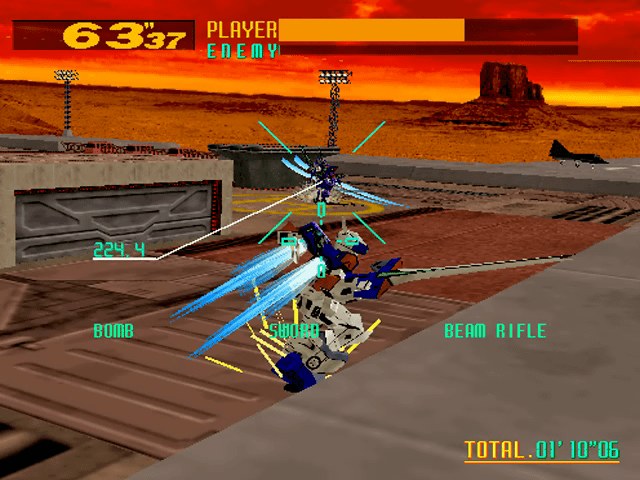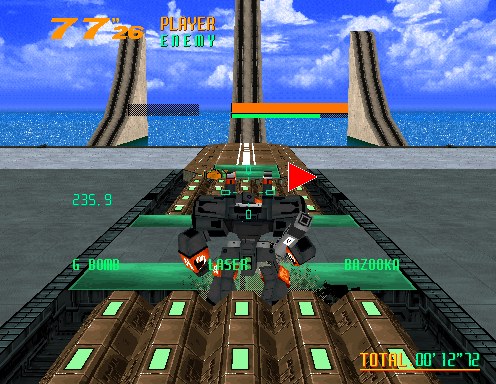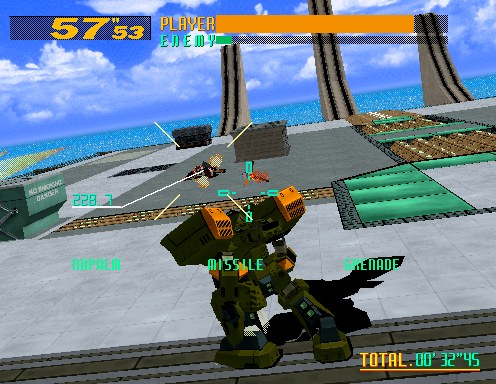
Thorhax, the author of the native Daytona USA and Virtua Fighter 2 ports, has brought another Sega Model 2 arcade game to Switch — Cyber Troopers Virtual-On (Model 2B board, MAME set von). It is a static recompilation: the programs of the main i960 CPU and the sound 68000 are translated to C++ ahead of time and built for ARM64. The ADSP-21062 SHARC geometry DSP still runs through MAME’s interpreter, while the rest of the board — SCSP sound, geometry, rasterizer and tilemaps — is implemented natively.
The first release, v1.0.0, came out on 9 October 2026, and v1.2.0 from 10 October added 16:9 widescreen: the arena fills the screen edges with the real scene, the HUD stays centered, and 4:3 mode can be restored in the menu (Plus + Minus). On hardware the author measured a stable 57.52 FPS — the arcade board’s native rate — even on the heaviest arenas. A CPU overclock to 1428 MHz (e.g. via sys-clk) is recommended. Sound is mono by default: in stereo, recording video with the Capture button crashes the system recorder and Atmosphère.
What you need to run it: a Switch with Atmosphère custom firmware and the Homebrew Menu. Your own MAME ROM set von.zip goes next to von.nro in sdmc:/switch/von/ — no ROMs are included in the release. Controls use two sticks, like the arcade levers: ZL/ZR fire, L/R dash.
Download and details: https://github.com/Thorhax/Virtual-On-NX
Overclock: Required · Average FPS: 57.5
About the game
Cyber Troopers Virtual-On is a 3D action game by Sega AM3 for the Sega Model 2 arcade board. The cabinets appeared in Japan and Europe in early 1996 (some sources say December 1995) and in North America in May 1996. A Sega Saturn version came out the same year and a Windows version in 1997; in 2007 the game was remade for PS2, and in 2013 the original came out on Xbox Live Arcade and PSN (both re-releases in Japan only).
Players control huge combat robots — Virtuaroids, or VRs — and fight one-on-one in 3D arenas; the cabinet had two lever joysticks for this. In the story, the Virtual-On machine itself is a remote control device sent from the future to find suitable pilots. The mechs were designed by Hajime Katoki; the game started a series, and the sequel Oratorio Tangram came out in 1998.
Screenshots